Data Governance Governs What Exists.
Why treating AI Governance as “just an extension” of Data Governance gets it wrong, and what to do about it before 2 August 2026.
Data Governance Governs What Exists. AI Governance Governs What Is Generated. That Changes Everything.
I keep seeing the same debate pop up on LinkedIn, at conferences, in vendor whitepapers. People asking: should Data Governance come before AI Governance? Are they the same thing? Are they complementary?
Honestly, we’re asking the wrong questions.
The real difference between the two isn’t about which team owns what, or which program you build first. It’s about something much more basic. What exactly are you trying to govern?
On one side, you’re governing things that already exist. Tables, records, pipelines, files. You can see them, trace them, fix them.
On the other side, you’re governing things that are generated by models that evolve over time, produce different answers to the same question, and increasingly make decisions on their own. Some of them now act on those decisions.
That’s not a difference in scope. It’s a difference in nature. And once you see it, you can’t unsee it.
The world Data Governance was built for
Data Governance is a mature discipline, and for good reason. It keeps your data clean, secure, accessible, and compliant. The stuff it manages, your customer records, your transaction tables, your master data, shares one essential trait. It’s already there. Someone collected it, stored it, cataloged it. You know what went in, and you can verify what comes out.
When something goes wrong, you trace the lineage. You check the schema. You apply a quality rule (complete? accurate? consistent?) and you get a yes or no. The pipeline is visible. The behavior is predictable.
And that matters. If your data house isn’t in order, nothing else works. AI inherits every problem your data layer already has. Start there. Always.
But here’s the thing. Data Governance is built around one core assumption: stability. Same input, same pipeline, same output, today, tomorrow, next quarter. Yes, modern data governance handles probabilistic data (fuzzy matching, ML-based classification, imputed values), but those are bounded exceptions inside a stable system. The expectation is that the system behaves the same way over time.
AI doesn’t work like that. Not even close.
What actually changes when you govern AI
A GoodData whitepaper [1], synthesizing enterprise implementations and regulatory analysis, puts it bluntly: “AI governance is not a minor extension of data governance, but a fundamental shift.”
Why? Because AI systems break three assumptions that traditional governance depends on.
First, AI systems aren’t static. A machine learning model doesn’t sit there like a database table. It evolves, through retraining, through feedback loops, through interaction with real-world data. Deploy a model today, and it may behave differently in three months. Not because you changed anything. Because the world changed around it. NIST’s Generative AI Profile (AI 600–1, July 2024) [2] identifies twelve risks unique to or exacerbated by generative AI, including confabulation, harmful bias or homogenization, information integrity, data privacy, and value chain integration. None of them fit a traditional “record is accurate or inaccurate” quality rule.
Second, humans can’t review every decision. Traditional governance assumes a person somewhere in the chain applies judgment. But a credit-scoring model running 10,000 applications per hour? A customer service agent handling thousands of conversations? No one is reviewing those one by one. The decisions are automated, the volume is massive, and someone still has to be accountable.
Third, quality isn’t binary anymore. Data governance validates verifiable properties. Is the record complete, accurate, consistent? You get a yes or no answer. AI governance has to manage something fundamentally different: confidence thresholds, statistical metrics, business tradeoffs. A fraud-detection model assigns a 73.6% probability of fraud to a transaction. Is that acceptable? It depends on context, on thresholds, on what the business is willing to lose to false positives versus false negatives. These aren’t quality attributes in the traditional sense. They’re judgment calls baked into the system itself.
Where the two actually diverge, five dimensions
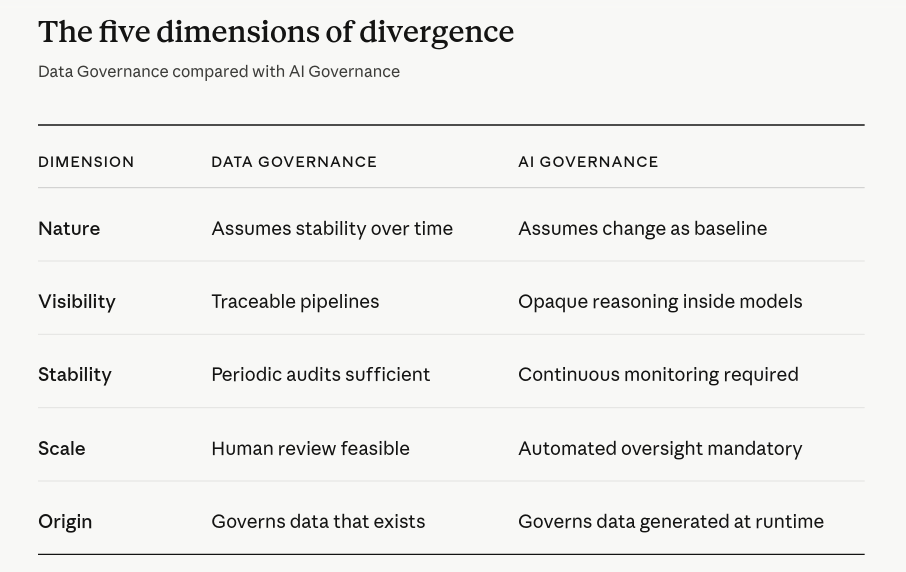
When I map Data Governance and AI Governance against each other on specific operational dimensions, the gap becomes concrete.
Source: Author’s analysis, informed by NIST AI RMF 1.0 and ISO/IEC 42001
Nature. Data Governance defaults to stability, same input, same output, exceptions managed as edge cases. AI Governance starts from the opposite assumption: uncertainty is the norm. The same prompt can give you a different answer every time you run it.
Visibility. Data pipelines are transparent. You trace a record from source to destination. AI models? Often a black box. You can’t always explain why the model made a particular decision. With generative AI, the reasoning lives in billions of parameters that no human can inspect.
Stability. Your data warehouse doesn’t change its behavior between quarterly audits. AI models do. They drift. They degrade. The NIST AI RMF [4] is built around this reality, positioning AI governance as a continuous lifecycle process rather than a one-time compliance check. That’s a fundamentally different operating model than what most governance teams are used to.
Scale. A data steward can inspect a dataset. An analyst can validate a report. But when an AI system makes thousands of autonomous decisions per second, human review of individual outputs isn’t realistic. You need automated monitoring, not manual spot-checks.
Origin. And this may be the biggest one. Data Governance governs data that already exists, collected, stored, ready to use. AI Governance has to deal with data that didn’t exist five seconds ago. Generative models create new content at runtime. LLMs and agents produce millions of new records daily. Without proper tagging, that synthetic data leaks back into primary databases. Train a future model on it, and you get what Shumailov et al. documented in Nature in July 2024 [3]: model collapse. AI learning from AI, with irreversible degradation in the resulting models. Hallucinations compound hallucinations.
Here’s a scenario that makes this real. A marketing team uses an LLM to generate 10,000 product descriptions. Those descriptions land in the data warehouse with no tag indicating they’re AI-generated. Six months later, another team trains a model on that warehouse. It learns the first model’s mistakes as if they were facts. This is a governance failure that no traditional data quality rule would catch, because the data looks fine. It just isn’t real.
Agentic AI makes it harder
And then there’s the agentic wave, which takes everything I just described and adds autonomy to it.
When an AI agent can plan, execute, chain actions across systems, and deploy outputs, all without a human pressing “approve”, you’re no longer governing a model. You’re governing a system that acts.
McKinsey’s State of AI Trust in 2026 [5] captured this distinction sharply: organizations can no longer concern themselves only with AI systems saying the wrong thing. They must now contend with systems doing the wrong thing. Taking unintended actions, misusing tools, operating beyond appropriate guardrails.
The scale is real, and the governance gap is wider than most executives realize. OutSystems’ 2026 State of AI Development report [6], based on nearly 1,900 global IT leaders, found that 96% of organizations already use AI agents in some capacity, and 94% are concerned about AI sprawl, the uncontrolled proliferation of agents creating complexity, technical debt, and security risk. Only 12% have implemented a centralized platform to manage that sprawl.
This mirrors previous shadow IT crises, but with higher stakes. AI agents don’t just store and retrieve data. They decide. They execute. They take actions in your systems.
They’re connected, but not the same
I don’t want to leave the impression that these are two disconnected worlds. They share real common ground. Both care about trust. Both need clear ownership and accountability. Both enforce quality. Both deal with security and privacy. An organization with strong data governance has a genuine head start.
But, and I want to be direct, AI governance without solid data governance is an illusion. If your data is unreliable, your models will be unreliable. No amount of AI-specific governance fixes that.
Just don’t stop there. Because data governance alone won’t help you with model drift, algorithmic bias, explainability, risk classification under the EU AI Act, content provenance, or accountability for autonomous decisions. Those are AI governance problems, and they need AI governance solutions. Solutions informed by frameworks purpose-built for AI, like NIST AI RMF 1.0 with its GenAI Profile, or ISO/IEC 42001 [7], the first international management-system standard for AI, published in December 2023.
The cleanest way I’ve found to describe the relationship: AI governance absorbs data governance, extends it, and goes beyond it. It absorbs it because clean data is still the non-negotiable foundation. It extends it because models, prompts, outputs, and decisions all need lineage and quality controls too. And it goes beyond it because you now have to govern drift, behavior, explainability, and autonomous action. None of which existed as governance objects five years ago.
I’ve been doing this for over 20 years. Across data architecture, BI, and now AI. And I can tell you: data governance had the luxury of time to settle into something stable. The technology underneath it didn’t change every six months. AI governance isn’t getting that.
The regulatory clock is no longer abstract
Here’s something that changes the urgency. On 2 August 2026, the majority of rules under the EU AI Act [8] come into force and enforcement begins at national and EU level. Transparency obligations under Article 50 start to apply. Rules for high-risk AI systems listed in Annex III enter into application, though the Commission’s Digital Omnibus package has proposed linking the application of those high-risk rules to the availability of harmonised standards, so the timeline for that piece specifically is still in flux. Rules for general-purpose AI models have been applying since August 2025. Penalty regimes are already in place at Member-State level.
And if you’re reading this outside the EU, don’t assume it doesn’t concern you. The Act applies extraterritorially: it governs any AI system whose outputs are used in the EU, regardless of where the provider or deployer is based. If your models touch European users or data, you’re in scope. The EU AI Act is also the first major binding AI regulation to enter enforcement at scale, which is why I’m using its timeline as the reference point. Canada’s AIDA, Colorado’s AI Act, and China’s generative AI rules are advancing in parallel with similar governance demands. The EU deadline just happens to be the most concrete.
If your governance program has been running on a “we’ll figure it out” cadence, the time window is closing fast. Governance in 2026 isn’t a maturity discussion. It’s a compliance deadline.
Three things you can do right now
If your organization has a data governance program and is starting to deploy AI, here’s where to start.
Move from periodic audits to continuous monitoring. Quarterly data quality reviews aren’t enough for systems that drift between audits. This is where NIST AI RMF’s Measure function becomes operational. Real-time tracking of model performance, bias indicators, output distributions, and for agents, the actions they’re taking in your systems, not just the outputs they produce. Point-in-time audits don’t catch drift. Continuous measurement does.
Build a model and agent registry that captures behavior, not just versions. Your data catalog tells you what data you have and where it lives. Your AI registry has to go further. Expected behavior, performance thresholds, training-data provenance, deployment boundaries, accountability. ISO/IEC 42001 gives you the scaffolding, 38 controls across nine governance areas, auditable the same way ISO 27001 is. If you want your AI governance program to stand up to an external audit, this is the standard you build toward. Version numbers alone are not governance.
Tag AI-generated content at the source, and enforce it. This is no longer a good-practice recommendation. It’s becoming law. Article 50 of the EU AI Act, enforceable from August 2026, requires transparency for AI-generated content. Anything produced by an AI system needs a label before it enters any data store. Prohibit training on unlabeled AI-generated content. For external distribution, the C2PA standard [9] (Content Credentials) is the emerging provenance baseline. Adobe, Microsoft, Google, and major camera manufacturers have adopted it. This single policy prevents model collapse and aligns you with a regulation that lands in three months.
It’s a mindset shift
The real question isn’t “which comes first” or “how do they overlap.” It’s whether your organization understands that governing AI requires thinking differently.
Data Governance assumes stability. AI Governance assumes change.
One validates what’s known. The other monitors what’s evolving.
One checks quality at defined checkpoints. The other watches for drift all the time.
One traces lineage backward. The other has to anticipate behavior forward.
One governs what systems are. The other governs what systems do.
Data governance builds trust in your information assets. AI governance builds trust in how your systems behave.
If you treat AI Governance as an add-on to your existing data governance program, a few extra fields in the catalog, model ownership assigned to your data stewards, the same audit cadence, you’ll find yourself unprepared when a model drifts, an agent acts on its own, or generated data corrupts your training pipeline. Or, increasingly, when a regulator asks for evidence you don’t have.
The organizations getting this right are building governance for uncertainty. Continuous monitoring. Feedback loops. Explainability baked in. Accountability structures that work when no human was in the loop.
Where do you draw the line between Data Governance and AI Governance in your organization? Is it clearly defined, or has it just kind of evolved on its own?
I’d love to hear how you’re thinking about it.
References
[1] GoodData, From Data Governance to AI Governance: The Enterprise Blueprint for Responsible AI at Scale, September 2025. gooddata.com/resources/from-data-governance-to-ai-governance-the-enterprise-blueprint-for-responsible-ai-at-scale
[2] Autio, C., Schwartz, R., Dunietz, J., Jain, S., Stanley, M., Tabassi, E., Hall, P., Roberts, K., Artificial Intelligence Risk Management Framework: Generative Artificial Intelligence Profile (NIST AI 600–1), NIST, July 2024. DOI: 10.6028/NIST.AI.600–1
[3] Shumailov, I., Shumaylov, Z., Zhao, Y., Papernot, N., Anderson, R., Gal, Y., “AI models collapse when trained on recursively generated data,” Nature 631, 755–759, July 2024. DOI: 10.1038/s41586–024–07566-y
[4] NIST, Artificial Intelligence Risk Management Framework (AI RMF 1.0), January 2023. nist.gov/itl/ai-risk-management-framework
[5] McKinsey & Company, State of AI Trust in 2026: Shifting to the Agentic Era, March 2026. mckinsey.com/capabilities/tech-and-ai/our-insights/tech-forward/state-of-ai-trust-in-2026-shifting-to-the-agentic-era
[6] OutSystems, 2026 State of AI Development, April 2026.
[7] ISO/IEC 42001:2023, Information technology, Artificial intelligence, Management system, International Organization for Standardization, December 2023. iso.org/standard/42001
[8] Regulation (EU) 2024/1689, Artificial Intelligence Act, Official Journal of the European Union, 12 July 2024. Implementation timeline via the European Commission AI Act Service Desk. ai-act-service-desk.ec.europa.eu
[9] Coalition for Content Provenance and Authenticity (C2PA), Technical Specification, v2.2, May 2025. c2pa.org