Key Breakthroughs: How AI Is Transforming Genetic Research
5 key breakthroughs reshaping how we decode and cure genetic diseases
 Decoding the Future: The Convergence of DNA and AI (Source DALL-E)
You've heard the buzz around AI. But did you know it's on the brink of changing how we decode and cure genetic diseases? Imagine diagnosing Parkinson's years before symptoms start — or editing faulty genes with near-perfect precision. Sound futuristic? It's happening right now.
1. AI Tackles the Data Deluge
Traditional genetic research used to feel like searching for a single grain of sand on a giant beach:
- Sanger sequencing and microarray technology gave us our first real insights into DNA.
- High-throughput sequencing then created such vast data that older methods struggled to keep up.
Enter AI: Machine learning and deep learning algorithms thrive on massive, complex datasets. They can:
- Spot patterns in large amounts of genomic information.
- Identify subtle gene variants linked to diseases.
- Predict how different genes interact within the body.
 Artificial Intelligence Decoding the Blueprint of Life (DALL-E)
Key takeaway: AI turns oceans of genomic data into actionable insights — fast.
2. Earlier, More Accurate Diagnosis
Ever wish you could detect a disease before it strikes? AI is making that possible, especially for neurodegenerative diseases like Parkinson's.
Early Detection
- Machine learning models analyze brain scans, patient histories, and even speech or gait patterns.
- Some can spot early Parkinson's before the classic tremors or stiffness appear.
Subtyping & Personalization
- Deep learning techniques cluster patients into distinct "types" of a disease — like slow vs. rapid-progressing Parkinson's. Researchers at Weill Cornell Medicine identified three distinct subtypes based on progression rates.
- Each subtype may respond better to certain drugs or lifestyle changes. For example, the Rapid Pace subtype (PD-R) has shown potential improvement with the diabetes drug metformin.
Why this matters: Earlier detection means earlier intervention — potentially slowing disease progression and improving quality of life.
3. AI Supercharges Drug Discovery
Drug development has traditionally been:
- Slow (often 10+ years).
- Expensive (billions of dollars).
- High-risk (most candidates fail).
AI speeds things up by:
- Drug Repurposing: Algorithms sift through thousands of FDA-approved drugs for new uses — like the Cleveland Clinic suggesting the cholesterol drug simvastatin might help Parkinson's patients.
- Molecular Target Discovery: AI can unearth hidden biomarkers or novel targets that humans might miss. For instance, new AI methods can predict gene activity in any human cell, revealing potential targets for multiple diseases.
Real-world impact: Faster, cheaper treatments mean patients get help sooner, and even rare diseases see more focused R&D.
4. A Virtual Genetic Engineer: CRISPR + AI
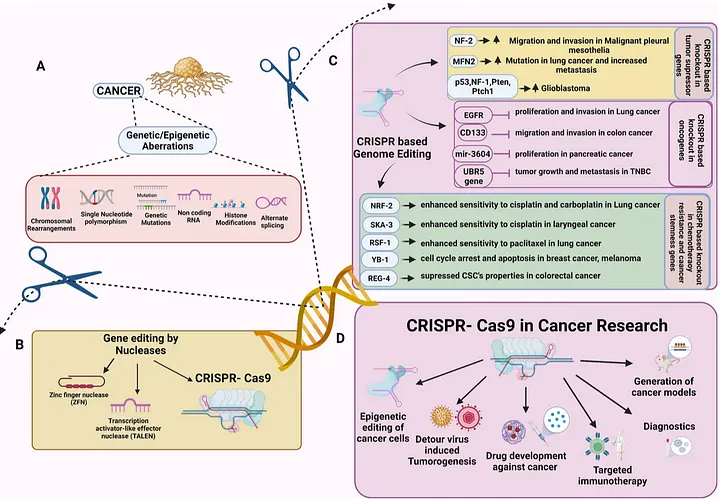 Schematic overview of the use of CRISPR/Cas9 in cancer research, targeting genetic and epigenetic alterations for the discovery of biomarkers and treatments. (Journal of Translational Medicine)
Gene editing with CRISPR is already revolutionary. Pair it with AI, and you get precision editing with fewer off-target effects.
- Predicting Outcomes: AI tools forecast how a specific CRISPR edit — like a base substitution — will affect the genome.
- Generative Genomics: Models like Evo 2 and CODA can design entirely new DNA sequences. Evo 2, trained on the DNA of over 100,000 species, can predict the effects of mutations and design new genomes. CODA can create novel regulatory elements to precisely control gene activity.
Bottom line: AI-guided CRISPR could reduce trial-and-error in the lab and speed up breakthroughs in gene therapy — potentially curing inherited diseases at their genetic roots.
5. AlphaFold 3: The Next Leap in Structure Prediction
If AlphaFold 2 revolutionized the way we predict protein structures, AlphaFold 3 promises to push that revolution even further. This latest iteration, highlighted by Frontline Genomics, takes on more complex proteins and interactions:
- Enhanced Accuracy: It refines protein models to better capture subtle folding patterns and potential binding sites.
- Faster Computations: Improved algorithms potentially lower computational costs, making large-scale protein studies more feasible.
- Expanding Drug Discovery: By modeling protein structures with greater precision, AI systems can identify novel drug targets and improve the speed of virtual screening.
Looking forward: As AlphaFold 3 continues to evolve, it could unlock new dimensions in personalized medicine, understanding rare genetic mutations, and guiding protein engineering — all while reducing the time and cost of experimental work.
6. Ethics: The Frontier We Must Not Ignore
With great power comes great responsibility. AI in genetics raises critical questions:
- Data Privacy & Bias: Who controls your genetic info? Are AI models inadvertently biased because of incomplete data on certain ethnic groups? For instance, genetic databases have historically contained more data from individuals of European descent, potentially leading to less accurate predictions for other populations. Researchers at the University of Florida have developed an AI tool called PhyloFrame to address this ancestral bias in genetic data.
- Transparent AI Decisions: Black-box models can be hard to trust if we don't know how they arrive at conclusions.
- Genome Editing Boundaries: If AI can design or alter human genes, where do we draw the line ethically? The World Health Organization (WHO) has emphasized the need for global standards and responsible innovation in human genome editing. The FDA also provides guidance for developers of AI/ML-enabled medical devices, focusing on safety, effectiveness, and addressing bias.
Key takeaway: Researchers, policymakers, and ethicists must collaborate to ensure genetic advances benefit everyone — without compromising privacy or fairness.
Conclusion: A Future Powered by AI and Genetic Insight
AI has moved us beyond merely describing DNA to predicting and engineering it. From diagnosing Parkinson's in its earliest stages to designing new DNA sequences from scratch, AI is reshaping every corner of genetic research.
But don't forget:
- Stay tuned to new research — updates in AI happen fast
- Look out for ethical guardrails — we want innovations that are safe and equitable
- Expect more personalized medicine — one day, your unique genetic profile may guide exactly which treatments you'll receive.
If you're fascinated by how AI is accelerating the next era of genetic breakthroughs, be prepared: we're only at the start of the revolution.
References
- AlphaFold 3: Stepping into the future of structure prediction — Frontline Genomics, accessed March 20, 2025, https://frontlinegenomics.com/alphafold-3-stepping-into-the-future-of-structure-prediction/
- Genetic data bias, why it matters and how to fix it — Science Museum Group Blog, accessed March 20, 2025, https://blog.sciencemuseumgroup.org.uk/genetic-data-bias-why-it-matters-and-how-to-fix-it/
- Artificial Intelligence and Machine Learning (AI/ML)-Enabled Medical Devices | FDA, accessed March 20, 2025, https://www.fda.gov/medical-devices/software-medical-device-samd/artificial-intelligence-and-machine-learning-aiml-enabled-medical-devices
- Human genome editing — World Health Organization (WHO), accessed March 20, 2025, https://www.who.int/health-topics/human-genome-editing
- New subtypes of Parkinson's Disease can be defined by Machine Learning — BiotechReality, accessed March 20, 2025, https://www.biotechreality.com/2024/07/new-subtypes-of-parkinsons-disease-can-be-defined-by-machine-learning.html
- Machine Learning Helps Define New Subtypes of Parkinson's Disease | Newsroom, accessed March 20, 2025, https://news.weill.cornell.edu/news/2024/07/machine-learning-helps-define-new-subtypes-of-parkinson%E2%80%99s-disease
- The Effect of Bias in Genomic Studies — BioTechniques, accessed March 20, 2025, https://www.biotechniques.com/news/the-effect-of-bias-in-genomic-studies/
- Artificial Intelligence and Medical Products — FDA, accessed March 20, 2025, https://www.fda.gov/media/177030/download
- WHO Panel Recommends Global Standards for Oversight and Governance of Human Genome Editing | National Academies, accessed March 20, 2025, https://www.nationalacademies.org/news/2021/07/who-panel-recommends-global-standards-for-oversight-and-governance-of-human-genome-editing
- Summary of Principles and Recommendations — Human Genome Editing — NCBI Bookshelf, accessed March 20, 2025, https://www.ncbi.nlm.nih.gov/books/NBK447280/