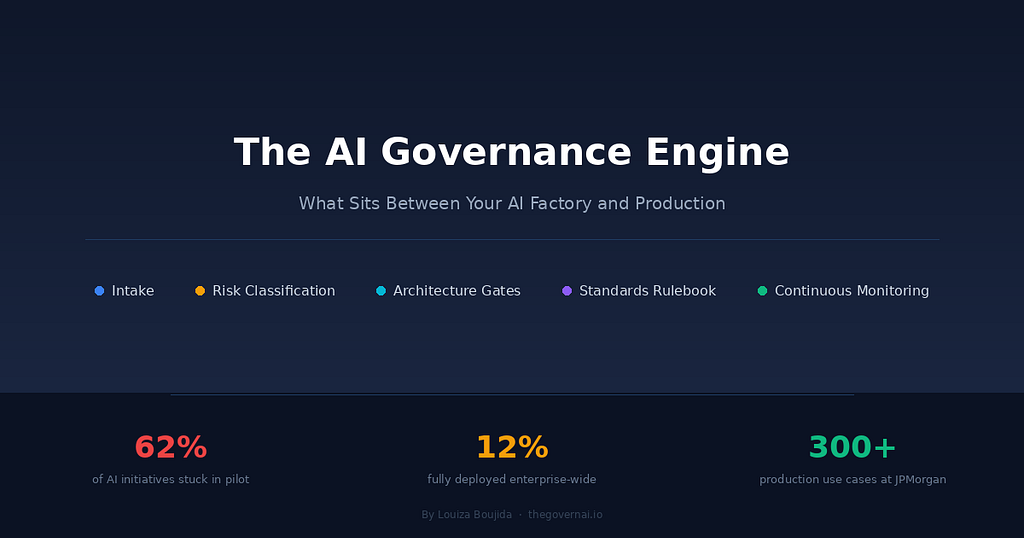
The AI Governance Engine: What Sits Between Your AI Factory and Production
The AI Governance Engine: What Sits Between Your AI Factory and Production
The Big Question Nobody Is Answering
Financial services is the single biggest industry investor in AI globally, with an estimated $73 billion in spending in 2026, representing over 20% of all global AI spending.[1] JPMorgan Chase alone invests $18 billion in technology, with AI driving $1.5 billion in annual business value and over 300 use cases in production.[2] Goldman Sachs deployed its AI assistant to all employees, Morgan Stanley achieved 98% adoption among financial advisors, and HSBC processes over a billion transactions monthly through its AI-powered AML system.[3]
And yet, across the industry as a whole, only 12% of AI initiatives are fully deployed enterprise-wide. Sixty-two percent remain stuck in pilot or development phases.[4]
That is not a technology problem. The models work. The cloud infrastructure is there. The talent exists. What is missing is what sits between the AI Factory and production: the governance engine that decides what moves forward, what gets blocked, and under what conditions.
Most conversations about scaling AI in financial services focus on the technology (which LLM? which cloud?) or the organization (do we need a Center of Excellence? an AI Factory?). Very few focus on the operational machinery that actually moves a use case from “interesting idea” to “running in production, touching real clients, and being monitored.”
That operational machinery is what I call the AI Governance Engine.
The AI Factory Is Necessary but Insufficient
The concept of an AI Factory has gained traction across global banking. JPMorgan Chase has described its strategy as building an “AI Factory” that generates value through network effects, operational leverage, and enterprise-wide data synergies, with the goal of lowering the marginal cost of the next AI application to near zero.[5] National Bank of Canada has built its own AI Factory, a structure designed to move AI from research into production while keeping governance, ethics, and decision-making tightly integrated.[6] These are different institutions with different scales, but the structural idea is the same.
The AI Factory solves the organizational question. But even the best AI Factory will stall without the governance engine that connects it to production.
The idea is sound: centralize AI capabilities, co-locate research and delivery, and treat AI as an operational function rather than a lab experiment.
But here is the thing. An AI Factory is an organizational structure. It tells you who works on AI and where they sit. It does not tell you how a use case moves from idea to production.
That “how” is the governance engine.
Without it, your AI Factory produces proof-of-concepts that die after the demo. Your data scientists build impressive models that never see a client. Your architecture team reviews solutions after they are already built, instead of before. And your compliance team becomes a bottleneck because they were brought in at the last mile instead of the first.
The institutions that are generating real value from AI, the JPMorgans and the Morgan Stanleys, share a common trait: they invested 3 to 5 years in fundamental infrastructure and governance development before reaching enterprise scale.[3] The technical capability matters, but it is the operational machinery that makes it work.
So what does that machinery actually look like?
Five Components That Make the Difference
I think about the governance engine as five connected components.
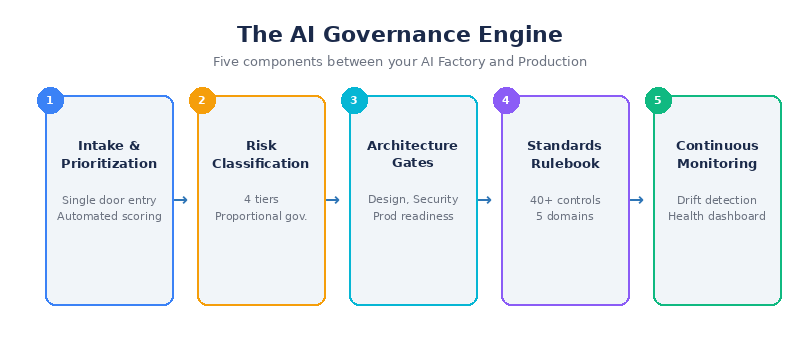
The five components of an AI Governance Engine, from intake to continuous monitoring
1. Intake and Prioritization
Every organization has more AI ideas than it has capacity to deliver. The first function of a governance engine is to create a single door through which all AI use cases enter, and a systematic way to evaluate them.
This is not a suggestion box. It is a structured intake form that captures the business problem, the data sources involved, the expected users, the risk profile, and the regulatory implications. All of this before a single line of code is written.
The intake form should include automated risk scoring. When someone submits a use case, it gets classified based on data sensitivity, user impact, and regulatory exposure. This classification determines the path the use case will take through the rest of the engine.
Why this matters: every major bank has dozens of teams requesting AI capabilities simultaneously. Wealth management wants a client summarizer, risk wants anomaly detection, compliance wants document classification. Without a formal intake process, the loudest voice or the most senior sponsor wins. Not the highest-value or lowest-risk use case.
2. Risk Classification
Not all AI use cases carry the same risk. A chatbot that summarizes internal meeting notes is fundamentally different from a model that influences credit decisions. The governance engine needs to reflect that.
I think about risk in four tiers:
Tier 1, Self-Serve. Low-risk, internal use cases with no client-facing output. Think AI-assisted code review, internal document search. Minimal governance gates. Teams can proceed with lightweight review.
Tier 2, Standard Review. Moderate risk, may touch client data or influence internal decisions. Think predictive analytics dashboards, automated report generation. Requires architecture review and data assessment.
Tier 3, Enhanced Review. High risk, client-facing or regulatory-adjacent. Think AI-generated client communications, fraud detection models. Requires security review, compliance sign-off, and bias testing.
Tier 4, Executive Approval. Critical risk, direct impact on financial decisions or regulatory obligations. Think credit scoring augmentation, automated trading signals. Requires committee-level approval, full audit trail, and ongoing monitoring.
The key insight is that governance should be proportional. If you apply Tier 4 scrutiny to a Tier 1 use case, you kill innovation. If you apply Tier 1 scrutiny to a Tier 4 use case, you create existential risk. This is why JPMorgan can run 300+ use cases in production while maintaining governance standards that others aspire to match.[2] The secret is not less governance. It is the right amount of governance for each use case.
One nuance worth noting: pre-approved enterprise AI tools, like Microsoft 365 Copilot or GitHub Copilot, typically fall into Tier 1 or Tier 2 by default. The vendor has already handled security certification, data residency, and compliance. The governance effort shifts from architecture review to adoption standards: who gets access, what data can be used, and what the acceptable use policies are. This is a different kind of governance, more about enablement than control. Custom-built solutions using LLM APIs or open-source models, on the other hand, start at Tier 2 or higher because the organization owns the full risk surface.
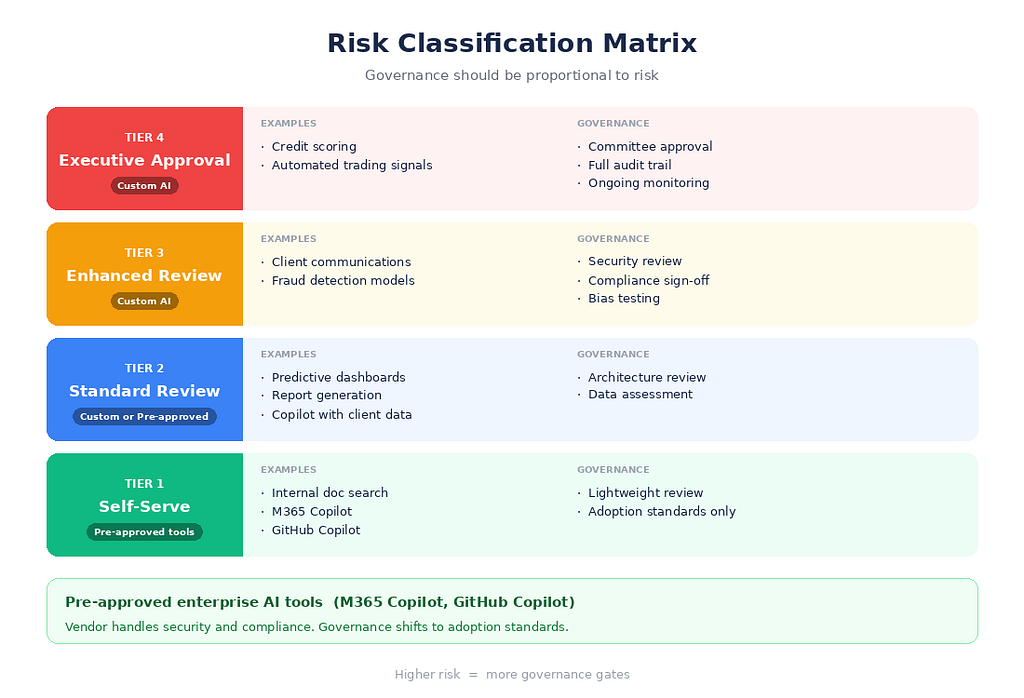
A four-tier risk classification matrix. Pre-approved tools like M365 Copilot fall into Tier 1 by default.
3. Architecture Gates
Before a use case reaches production, it should pass through a series of architecture gates. These are structured checkpoints where different teams validate different aspects of the solution.
Three gates work well in practice:
Gate 1, Design Review. The solution architect presents the proposed architecture. Is it modular? Is it secure? Does it follow the organization’s cloud patterns? Does it use approved services and APIs? This happens before development begins.
Gate 2, Data and Security Review. The data team validates data lineage, quality, and access controls. The security team reviews authentication, encryption, and data handling. The compliance team confirms regulatory alignment. This happens after development, before deployment.
Gate 3, Production Readiness. The operations team validates monitoring, alerting, rollback procedures, and SLA commitments. The governance team confirms the audit trail is complete. This happens before go-live.
The regulatory landscape makes these gates non-optional. The EU AI Act now requires significant compliance investments for AI systems used in credit decisions.[3] IOSCO’s 2025 framework establishes six measures for AI governance in capital markets, including senior management oversight and robust testing obligations.[3] In Canada, OSFI E-23 and Quebec’s Loi 25 add further layers. These are not abstract requirements. Architecture gates are where they become operational reality.
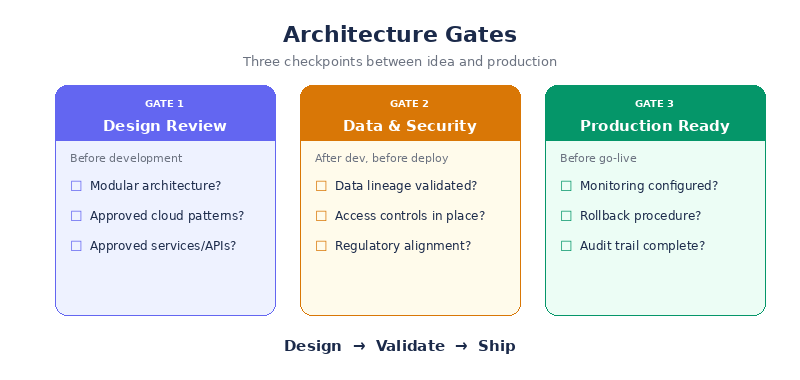
Three architecture gates: Design, Validate, Ship. Each gate involves different teams and checkpoints.
4. Standards Rulebook
A governance engine needs a codified set of standards. Not abstract principles, but concrete, enforceable rules that teams can follow.
A solid rulebook covers five domains:
Data Governance. How is training data sourced, validated, and versioned? What are the retention policies? How is PII handled?
Model Governance. How are models tested, validated, and versioned? What bias testing is required? What are the accuracy thresholds?
Security. What authentication and authorization patterns are required? How are API keys managed? What encryption standards apply?
Operations. What monitoring is in place? What are the alerting thresholds? What is the rollback procedure? Who is on call?
Ethics and Compliance. Is there a human-in-the-loop? Can the model’s decisions be explained? Does the use case comply with applicable regulations?
These controls should not be aspirational. They should be checkbox items that must be satisfied before a use case passes through an architecture gate. Forty controls across five domains is a reasonable starting point for most organizations.
5. Continuous Monitoring
Production is not the finish line. It is the starting point for a new set of governance obligations.
Models drift. Data distributions change. User behavior evolves. Regulatory requirements shift. A governance engine must include continuous monitoring that detects when a production AI system is no longer performing within its approved parameters.
This includes model performance metrics (accuracy, latency, error rates), data quality checks (schema changes, null rates, distribution shifts), and usage monitoring (who is using the system, how often, and for what).
The US Government Accountability Office noted in 2025 that existing model risk management principles already apply to AI, including testing and independent oversight.[7] In practice, this means prompts and outputs are logged, performance is monitored for drift, and humans remain responsible for high-impact decisions. A unified health score dashboard that aggregates all of these signals into a single view makes it possible for a governance team to monitor dozens of production models without drowning in alerts.
Why Governance-First Cultures Win
There is a pattern in the data. The institutions that are successfully scaling AI are not the ones that move fastest. They are the ones that built governance into their delivery pipeline from the start.
The 2025 Evident AI Index, which ranks the 50 largest global banks on AI maturity, found that seven of the top ten and eleven of the top twenty are headquartered in North America.[8] The common thread is not geography. It is the combination of heavy investment in talent, comprehensive governance frameworks, and systematic performance measurement.
Canadian banks offer a particularly interesting case. They operate in an environment where trust is not just a regulatory requirement but a cultural expectation. The OSFI’s guidelines on technology risk, Quebec’s Loi 25 on privacy, and the broader influence of the Montreal Declaration for Responsible AI create a governance-first mindset that turns out to be an advantage when scaling AI. As Julien Crowe, Senior Director of AI at National Bank of Canada, put it: “Our focus will remain on seamless collaboration between risk management, value creation, and technical experts to deliver solutions to our clients’ needs.”[6]
But this is not a Canadian story. It is a global pattern. Whether it is JPMorgan investing in governance infrastructure alongside its 300+ production use cases, or HSBC embedding compliance into its AML system from day one, or Morgan Stanley achieving near-universal adoption through careful change management, the winning formula is the same: governance is not the brake. It is the engine.
The Governance Engine Is the Competitive Advantage
Here is the thing that took me years to understand. The governance engine is not a tax on innovation. It is what makes innovation possible at scale.
When teams know exactly what is required to get to production, they design for it from day one. When the intake process is clear, the right use cases get prioritized. When risk tiers are defined, teams spend their energy building instead of arguing about process. When architecture gates exist, security and compliance stop being last-minute blockers and start being early-stage collaborators.
The financial institutions that will win in 2026 and beyond are not the ones with the most sophisticated models or the biggest AI budgets. They are the ones that have industrialized the journey from idea to production, with a governance engine that is rigorous enough to satisfy regulators, fast enough to keep up with innovation, and transparent enough to maintain the trust that financial services depends on.
The AI Factory is the building. The Governance Engine is what makes it run.
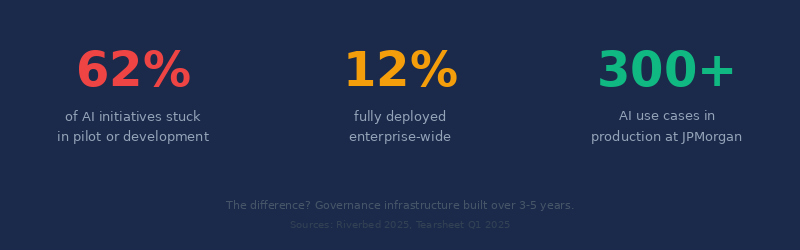
The gap between AI ambition and AI production is a governance problem, not a technology problem
References
[1] IDC Worldwide AI and Generative AI Spending Guide, via Market Clarity, “Where is AI Spending Going in 2026?”, November 2025. https://mktclarity.com/blogs/news/where-ai-spending-is-going
[2] Tearsheet, “The AI Reality Check, Q1 2025 Edition”, June 2025. https://tearsheet.co/artificial-intelligence/tearsheet-report-the-ai-reality-check-q1-2025-edition/
[3] Lucidate, “Beyond the Pilot: How JPMorgan, Goldman Sachs, and HSBC Are Scaling AI to Enterprise Production”, June 2025. https://www.lucidate.co.uk/post/beyond-the-pilot-how-jpmorgan-goldman-sachs-and-hsbc-are-scaling-ai-to-enterprise-production
[4] Riverbed Global Survey 2025, via Retail Banker International, “From AI pilots to AI performance”, February 2026. https://www.retailbankerinternational.com/comment/financial-services-next-step-operationalising-ai-at-scale/
[5] Klover.ai, “JPMorgan’s AI Strategy: Chasing AI Dominance”, July 2025. https://www.klover.ai/jpmorgan-ai-strategy-chasing-ai-dominance/
[6] The Digital Banker, “National Bank of Canada’s Julien Crowe: AI is powerful at predicting, but people remain indispensable for strategic decision making”, January 2026. https://thedigitalbanker.com/national-bank-of-canadas-julien-crowe-ai-is-powerful-at-predicting-but-people-remain-indispensable-for-strategic-decision-making/
[7] Artificial Intelligence News, “Wall Street’s AI gains are here, banks plan for fewer people”, December 2025. https://www.artificialintelligence-news.com/news/wall-street-ai-gains-are-here-banks-plan-for-fewer-people/
[8] Evident AI Index 2025, “Here’s the 2025 Evident AI Index”, 2025. https://evidentinsights.com/bankingbrief/heres-the-2025-evident-ai-index/
Louiza Boujida is an AI & Data Solution Architect with 20+ years of experience. She writes about AI governance and enterprise AI adoption at thegovernai.io and publishes on Medium and Towards AI.